The three buckets, in plain terms
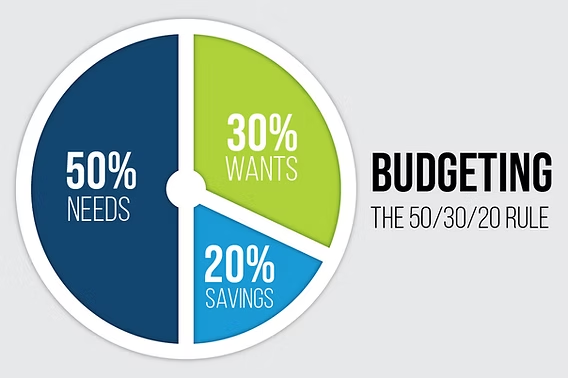
The 50/30/20 rule splits your after-tax income into three buckets: 50% for needs, the costs you can't avoid like rent, groceries, utilities, insurance, and minimum debt payments; 30% for wants, the discretionary spending that makes life enjoyable, dining out, streaming, hobbies, travel; and 20% for savings and extra debt payoff, the money building your future rather than covering today. It's deliberately simple. The appeal isn't precision, it's that you can check your spending against it in about thirty seconds.
The rule was popularized by Senator Elizabeth Warren and her daughter Amelia Warren Tyagi in their 2005 book on family finances, originally as a way to quickly judge whether a household's finances were structurally sound before digging into the details. It was never meant to be a precise formula, more a smoke test: if needs are eating 70% of income, something structural, usually housing, needs attention before any other budgeting advice will help.
What counts as a need versus a want
The line between the two buckets isn't always obvious, and that ambiguity is where most people get the split wrong. A basic phone plan is a need; a phone upgrade you don't require is a want. Groceries for the week are a need; the $18 takeout order instead of cooking is a want. Minimum payments on debt are a need, since missing them has real consequences, but any amount above the minimum is really savings, since it's optional in the short term even though it's a good idea. Being honest about this line, rather than classifying convenient spending as a need, is what makes the ratio useful instead of a number you can talk yourself into no matter what you spend.
A worked example at a real income level
Take someone earning $5,200 a month after tax. The rule suggests roughly $2,600 for needs, $1,560 for wants, and $1,040 for savings and extra debt payments. If their actual needs come to $3,100, rent, a car payment, insurance, groceries, utilities, that's $500 over target. Rather than trying to squeeze wants down to zero to compensate, which rarely lasts, the more durable fix is usually to attack the needs number directly: a cheaper insurance policy, a roommate, a different commute, refinancing the car loan. The ratio is useful here precisely because it shows where the actual gap is, instead of leaving the feeling of "spending too much" vague.
Where it falls apart, and what to do instead
The rule assumes your needs only take up half your income, which doesn't hold in every city or at every salary. If rent alone eats 45% of your take-home pay, forcing wants down to 30% and savings up to 20% isn't realistic without major lifestyle changes. In that case, treat the ratios as a direction rather than a mandate: aim to shrink the needs bucket over time through things like renegotiating bills or relocating, while protecting at least a small, non-negotiable savings percentage, even if it's 5 or 10% to start.
On the other end, if your income comfortably covers needs with room to spare, pushing your savings rate well past 20%, toward 30, 40, or even 50%, compounds faster than sticking rigidly to the ratio. The rule is a floor for savings discipline, not a ceiling. It's also worth noting the rule works on after-tax income specifically; applying it to gross income overstates how much you actually have to allocate once taxes are accounted for.
Adapting the ratios for specific situations
A few common variations are worth knowing. For high earners in expensive cities, a modified 60/20/20 or even 65/15/20 split is sometimes more realistic until the needs category can be brought down. For households aggressively paying off debt, some planners suggest a temporary 50/20/30, shifting more into the savings-and-debt bucket for a defined period rather than indefinitely. None of these variations are wrong, the point of the rule is to give you a reference point to measure against, not a law to follow exactly regardless of circumstances.
How to actually apply it each month
Start by categorizing last month's spending into the three buckets to see where you currently land. Then compare that against the 50/30/20 targets and decide where to adjust, usually by trimming the wants bucket first since it has the most discretionary room. Tracking this by hand each month is tedious; automatically tagging transactions through Fyscal Money's budgeting tools turns this into a running check rather than a monthly chore, and makes it easy to see the trend across several months rather than judging a single snapshot.
A starting point, not the only option
If the percentage split doesn't fit how you think about money, it's worth comparing it against other structures. See What Is a Budget? for the fundamentals, or read How to Create a Budget in 2026 for a step-by-step on building one from your own transaction history instead of a fixed ratio.